One database, several ways to ask
ShrikeDB keeps property graphs, RDF facts, OWL ontologies, vectors, key–value records, and geospatial observations under one entity identity. Cypher, SPARQL, SQL, and typed APIs lower into shared execution and storage services. The execution path changes with the question. The transaction boundary does not.

Move from a vector neighbor or location event to graph relationships and application records by UID.
A query pins a readable version. A commit publishes connected changes together.
The write-ahead log records durable intent before publication and drives restart recovery.
The transaction path
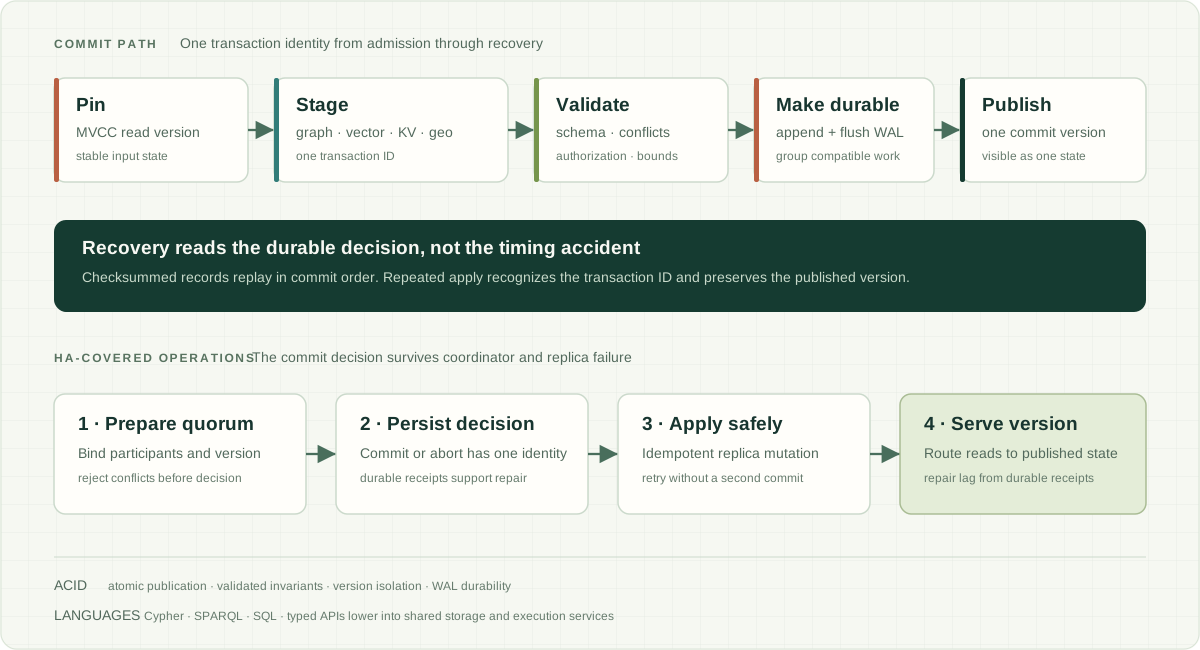
A transaction stages graph, vector, key–value, and geospatial changes under one commit identifier. Validation runs before publication. A successful commit makes the accepted changes visible as one state transition. A rejected or rolled-back transaction publishes none of them. If a connection drops during commit, the application resolves the transaction's recorded outcome before issuing another logical change.
Cypher, SPARQL, and SQL use the same planner and storage services for their accepted statement shapes. SQL exposes scalar and relational operations over TRIPLES, GRAPH.<label>, and table functions for vector, geospatial, and key–value search. It creates no separate relational copy.
ACID across connected data
Atomicity keeps a graph change and its related vector, payload, or observation in the same commit. Consistency applies schema, index, authorization, and conflict checks before publication. Isolation gives each read a pinned published version. Durability records an accepted commit in the WAL before the server reports it durable.
The useful consequence is simple: an application does not have to repair the interval in which a node exists but its embedding does not, or a geospatial observation appears without the entity update that explains it.
MVCC gives the query one history
Readers pin a published version for the duration of a request. Concurrent writers can prepare later versions without changing the state already visible to that query. Graph expansion, vector filtering, key lookup, and geospatial selection therefore agree on the same publication boundary.
Versioning also gives recovery and replication a precise order. A replica can reject stale work, recognize a repeated apply, and resume from a known durable point instead of guessing which index moved first.
The WAL is the recovery contract
ShrikeDB appends transaction records to its write-ahead log, groups compatible durability work, and publishes only after the required flush completes. On restart, recovery replays committed records in order and reconstructs the published state and its derived access paths.
Checksummed records, commit identities, and replay-safe operations make recovery repeatable. The design keeps durable bytes sequential while allowing index preparation and post-commit work to use parallel hardware.
Share the disk work. Keep each transaction.
A storage flush can make several transaction records durable at once. ShrikeDB's native storage replay supports bounded groups of admitted independent transactions. Each member keeps its own log record, commit identity, and recovery receipt. Sharing the flush reduces repeated storage work without turning separate application changes into one transaction.
Recovery advances through a complete durable log prefix. A later completed write cannot hide an earlier unfinished one. Once grouped commit owns the work, it continues through durability and publication even if its caller disconnects; orderly shutdown waits for that work to finish.
This grouping currently serves the native storage replay path. Public HA request batching remains a separate integration step. The HA guide explains recovery and application retry behavior.
HA keeps the decision durable
For HA-covered operations, a coordinator prepares the participating replicas, records the commit decision through quorum, and applies that decision idempotently. Durable receipts let repair distinguish a transaction that never committed from one whose decision survived while a replica was unavailable.
Write forwarding routes supported operations to the responsible leader. Replica apply uses the transaction identity and version to make retries safe. Read routing observes the published version required by the request.
| Surface | Commit and recovery | Deployment coverage |
|---|---|---|
| Typed graph, vector, KV, and geospatial transaction APIs | Atomic multimodal commit, MVCC read version, WAL recovery | Standalone; selected operations use HA quorum coordination and replica apply |
| Cypher mutations | Atomic request boundary on the native graph storage path | Standalone server |
| SPARQL updates | Atomic ordered update on the native RDF and graph storage path | Standalone server |
| SQL reads and graph-node mutations | Shared graph, vector, geospatial, and KV operators; graph DML uses the native graph-write service | Standalone server; SQL reads compose across native modalities |
| Distributed reads | Version-aware routing and result assembly | Bulk KV, packed and streaming vector, graph scan, and supported graph-scan Cypher/SPARQL shapes |
| ShrikeDB Cloud | WAL-backed single-writer service | HA mode is currently disabled for public tenants |
Configure and operate an HA cluster or review transactions and snapshot behavior.
Indexes meet at the entity
An entity UID connects its graph vertex, embedding, key–value payload, and geospatial observations. A vector result can start a graph pattern; a place-and-time result can lead to stored relationships. Each modality keeps an access path suited to its work while the application keeps one identity and one publication history.
This matters most in compound queries. “Find semantically similar reports from suppliers connected to this account during the affected interval” should not require three databases, an identity reconciliation job, and a prayer offered to the cache invalidation gods.
OWL turns vocabulary into executable context
ShrikeDB imports Turtle, RDF/XML, and OWL sources as queryable RDF facts. Optional Rust-native materialization computes supported class, property, equality, restriction, and role inferences before publication. SPARQL can query the resulting ontology graph directly; bounded ontology functions let Cypher test subclass, reachability, ancestor, descendant, and path relationships against the same graph snapshot.
Semantic profiles connect application labels and fields to ontology concepts. Query results can retain the grounding path that justified a class match, which gives an analyst evidence to inspect instead of a category that appeared by administrative magic.
Import and query an ontology or review semantic profiles and ontology bindings.
Derive relationships with their evidence
Co-location, repeated visits, shared counterparties, and other correlations depend on parameters chosen for the investigation. Cypher can return the matching entities and evidence as rows. SPARQL CONSTRUCT can return a result graph. An application can inspect that result before deciding whether any relationship belongs in durable state.
See the query-time graph example and a place-and-time conjunction.
Read Parquet without staging a copy
Register local Parquet and publish a reviewed mapping of source columns to graph concepts. Supported Cypher, SPARQL, HTTP, and MCP source queries project needed columns and apply bounded predicates against the registered files. The files remain authoritative, so exploration does not begin with another ingestion pipeline.
The mapping still defines identity, grain, and relationship meaning. Removing ETL removes a copy. It does not remove the data model. Connect a Parquet source.
Inspect the work
Graph plans expose operator work through EXPLAIN and PROFILE. SQL, Cypher, and SPARQL share physical services rather than maintaining language-specific copies. Source-backed responses identify the selected mapping and scan work. Transaction and HA diagnostics identify the database, version, decision, and recovery state needed to operate the system.